
Compare exposure conditions, not just product names
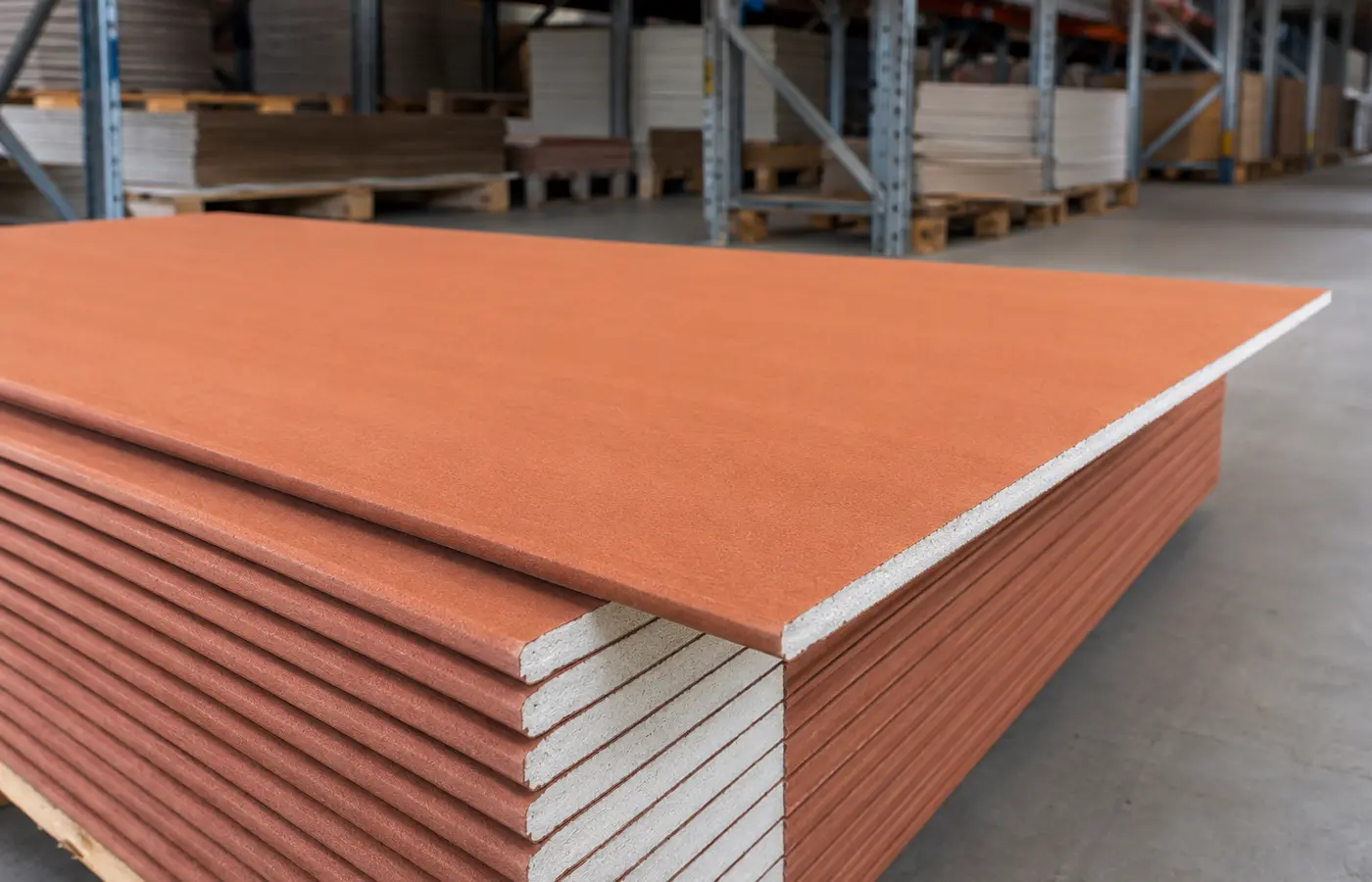
BoardeX and plasterboard belong to the dry-construction family, but they are not interchangeable in every location. Dalsan describes BoardeX as exterior sheathing with a water- and moisture-reinforced core and glass-fibre mat facing, intended under exterior cladding, at soffits and in interior wet areas. The plasterboard family, meanwhile, includes standard interior boards and specialist moisture- or fire-resistant grades.
The useful question is therefore not simply “BoardeX or plasterboard?” Establish which side of the envelope the board occupies, whether it sees rain or wind, the humidity and final finish, and the required fire, acoustic and structural performance. A board name alone never defines a complete wall or ceiling system.
Why BoardeX is considered behind exterior cladding
Sheathing behind an exterior finish can face harsher site and service conditions than an internal lining. BoardeX's glass-fibre mat surface and moisture-reinforced core were developed for this role. Where sheathing is needed behind metal, timber-effect or decorative façade finishes, assess BoardeX through the manufacturer's approved exterior-system details.
The board is still only one layer. Wind load, framing type and centres, fasteners, board orientation, joints, water and air control layers, insulation, cladding rails and opening details must work together. BoardeX does not replace structural design; confirm façade systems with the project engineer and current manufacturer documentation.
When standard plasterboard makes sense indoors
For a dry internal partition, wall lining or suspended ceiling in a home, office or shop, standard plasterboard is often a practical starting point. It offers a smooth finish and rapid dry construction, but thickness, number of layers, stud width, centres and insulation infill still depend on the project.
Do not leave cabinets, televisions, washbasins or heavy equipment supported by the board alone. Plan fixing points and use the backing, framing reinforcement and anchors specified by the system manufacturer. High-impact corridors, schools and commercial spaces may require a tougher board or a different tested build-up.
Is moisture-resistant plasterboard enough in a bathroom?
Moisture resistance is not waterproofing. A moisture-resistant board is selected for the indoor humidity conditions stated by its manufacturer; it does not alone create a watertight layer in a shower, continuously wetted area or leak-prone detail. Primer, waterproofing membrane, tapes, corners, pipe penetrations and joints must be designed as a compatible system.
Dalsan also identifies BoardeX for interior wet areas, but its name still does not complete the assembly. Check direct and prolonged water exposure, finish, membrane compatibility and fixings. For poolsides, steam rooms or intensive commercial wet areas, use the relevant system sheet and obtain technical approval before combining materials.
Fire and acoustic ratings belong to the system
Selecting a fire-resistant board does not automatically give a wall a stated fire-resistance period. Results such as EI ratings apply to the complete tested arrangement: board type and layers, framing, insulation, screws, joints and wall height. Knauf's system information likewise shows that different boards and assemblies produce different results.
Acoustic performance also depends on layers, cavity depth, mineral wool, perimeter sealing and service penetrations. Put the required rating in the enquiry and request the current manufacturer system that demonstrates it. Do not assume that substituting individual components preserves a declared result.
Five installation matches that matter
Even the right board can underperform with the wrong screw, frame or joint product. Match fasteners to board, metal gauge, total lining thickness and corrosion environment. Follow the manufacturer for head depth, edge distances and spacing so the facing is not torn.
Store boards flat, dry and clear of the floor; inspect for wetting, bowed sheets and damaged corners. Resolve doors, windows, services, movement joints and heavy-load supports before boarding. If components come from different product families, document their compatibility.
- Board type versus indoor/outdoor exposure and moisture class
- Frame section, centres and wall height
- Fastener type, length, spacing and corrosion protection
- Jointing, waterproofing and final finish
- Fire, acoustic, impact and suspended-load targets
A quick selection summary
For dry internal partitions, linings and ceilings, start with the specified standard or specialist plasterboard. In more humid interiors, assess moisture-resistant board together with the finish and waterproofing. Behind exterior cladding, at soffits or in the severe moisture conditions defined by the manufacturer, BoardeX and its approved details are the stronger candidate.
Do not order from this summary alone where fire, acoustics, tall walls, façade wind or structural safety is involved. Identify a tested system reference, current data sheet and project detail. Recheck any change of brand, board type or thickness with the designer and manufacturer.
Information to include in a useful quotation request
Send more than the square metres. A single message containing the following allows the boards and accessories to be compared properly:
- Location: façade, soffit, bathroom, partition, lining or ceiling
- Approximate area, wall height, ceiling span and available drawings
- Indoor/outdoor exposure to rain, direct water, humidity and coastal air
- Required board type, thickness, layers and system reference
- Fire, acoustic, thermal, impact and suspended-load requirements
- Framing, screws, insulation, tape, jointing, waterproofing and finish needed