
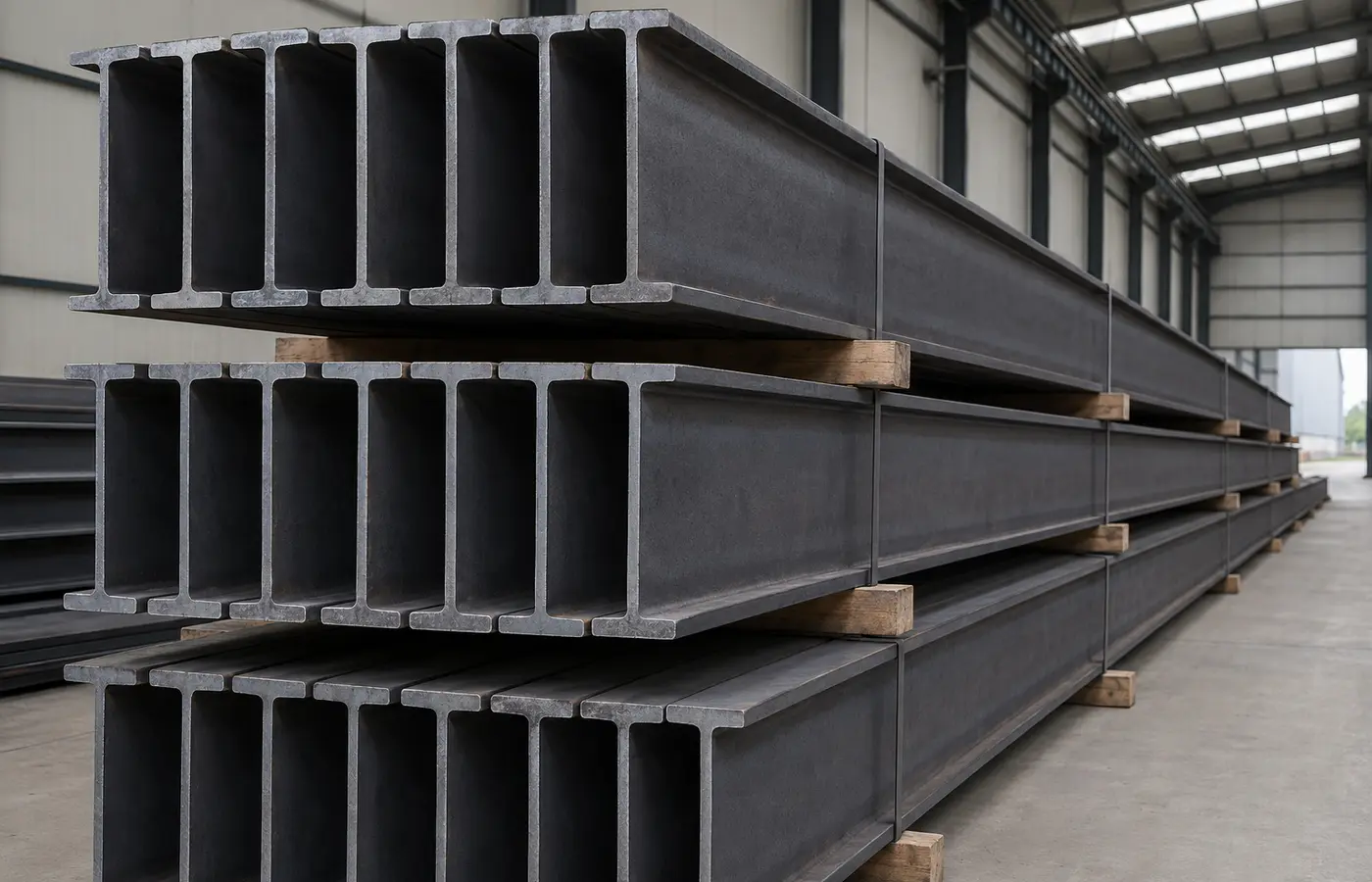
The same nominal number does not mean the same section
IPE, IPN, HEA and HEB are not interchangeable trade labels; they identify different section families and geometries. A shared nominal number does not guarantee the same actual depth, flange width, web thickness, mass per metre or structural behaviour. A request for a '200 section' is therefore incomplete.
ArcelorMittal's 2026 programme classifies IPE as a parallel-flange I section, IPN as a tapered-flange I section and HE as a wide-flange family. It references EN 10365 for dimensions, EN 10034 for IPE and HE tolerances, and EN 10024 for IPN tolerances. State the full series, size, steel grade, length and quantity in every enquiry.
IPE: a relatively narrow, parallel-flange I section
The inner and outer flange faces of IPE sections are essentially parallel, which can simplify flat contact with plates and certain bolted details. IPE is often used as a beam, but the label does not assign a structural role. Span, supports, load direction, lateral-torsional buckling, deflection, fire design and connections must all be checked.
Depth alone is insufficient. Technical tables may list area and mass together with major- and minor-axis second moments of area, elastic and plastic section moduli, radii of gyration and torsional properties. The engineer selects a section after checking strength, serviceability and stability.
IPN: the traditional I section with tapered flange faces
On an IPN, flange thickness reduces towards the outer edge, so the flange faces are not parallel as they are on an IPE. This affects washers, bolts, end plates, clamps and bearing surfaces. Hardware designed for parallel contact may not seat correctly on an IPN without a verified detail.
Finding IPN in an existing building does not make an equal-number IPE an automatic substitute. When identifying an existing member, a competent person should confirm flange slope, actual thickness and any section loss beneath coatings or corrosion. Replacement and strengthening decisions require engineering assessment rather than a catalogue-name match.
HEA and HEB: two series within the wide-flange family
HE sections have comparatively wide flanges and are common in columns, frames and members where behaviour about both axes matters, but the application name never replaces calculation. HEA and HEB use different proportions. Within a comparable nominal group, HEB is generally thicker and heavier than HEA, yet the current manufacturer's actual dimensions and properties must govern every comparison.
Heavier does not automatically mean better or more economical. Added mass affects purchasing, transport, lifting, cutting and welding; wider flanges may conflict with architectural clearances. Conversely, inadequate weak-axis behaviour, buckling resistance or connection capacity can be critical. The optimum choice depends on design actions and the construction method.
Do not confuse section family with steel grade
IPE, IPN, HEA and HEB describe shape; strength grade and delivery condition are separate. One geometry may be supplied in different steel grades. ArcelorMittal lists dimensional and tolerance standards separately from applicable grade standards, so 'HEB' alone says nothing complete about yield strength, impact requirements, weldability or inspection.
Transfer the exact grade designation, impact class where required, delivery condition and inspection-document requirement from the specification. Keep heat numbers and product markings traceable to the delivered pieces. Welding procedure, preheat, consumables and testing depend on material, thickness, joint and project requirements—not simply on the section name.
Match the technical table line by line before quotation
A useful enquiry includes series and nominal size, piece length, quantity, total requirement, grade, surface condition, cutting or drilling work, tolerances, documents and delivery method. If a supplier proposes an alternative, have the project engineer compare area, mass per metre, actual envelope dimensions, web and flange thicknesses and all relevant section properties. Never decide equivalence only by kilogram price or depth.
Plan transport and unloading too: piece length, bundle mass, lifting points, dunnage and crane access matter. Define cutting waste and piece identification. For load-bearing work, section selection, substitution, holes, welding and strengthening must follow the authorised engineer's calculations and applicable standards; this guide is not a structural design.