
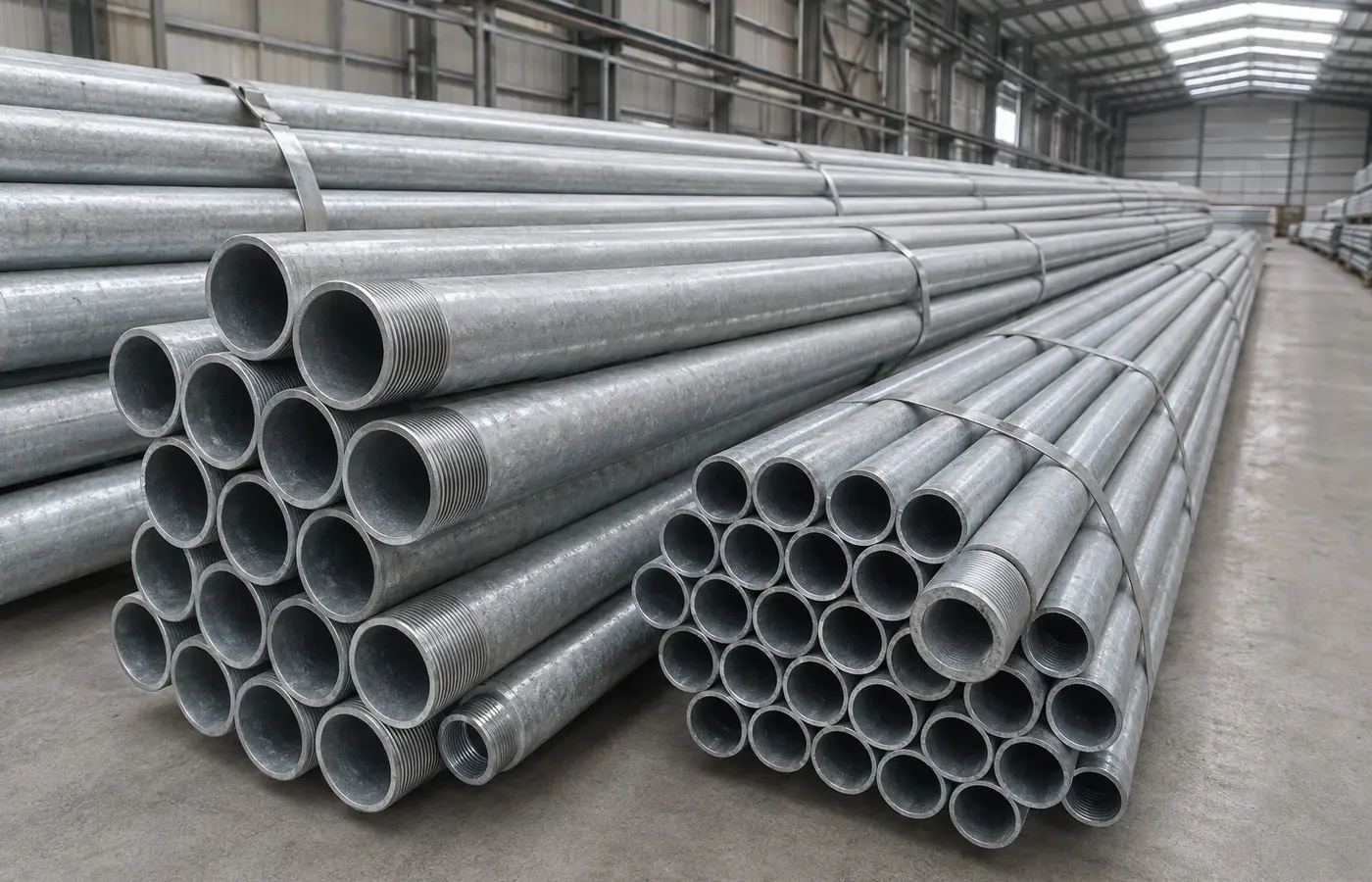
The trade term 'tested pipe' is not a complete specification
In some markets, tested pipe distinguishes steel tube made for specified piping duties and subjected to the tests required by its manufacturing standard. The label alone does not state the standard, series, wall, end form, test basis or inspection document. Ordering only by a nominal inch name leaves essential information unresolved.
Check product markings, manufacturer declaration, governing standard and any required inspection or test document together. Gas, fire, potable water, compressed air and process lines can have different legal and material requirements. Selection, system design and commissioning tests belong to the authorized designer and installer.
The basic difference is surface protection
Black tested pipe has no zinc coating, although it may carry oil or a dark mill finish for handling and temporary storage. Galvanized pipe has a zinc coating that acts as a barrier and can provide sacrificial protection at small discontinuities. This changes corrosion behaviour but does not automatically define pressure class or structural capacity.
A bright appearance does not prove coating thickness, internal coverage or service life. Verify the galvanizing method, coated surfaces and product standard. To treat black and galvanized pipes as dimensional alternatives, compare outside diameter, actual wall, material grade, end preparation and standard.
Service fluid and environment control the coating choice
Galvanizing may add protection outdoors, in humid rooms or under splash, but temperature, water chemistry, pH, chlorides, additives, condensation and flow affect zinc compatibility. Neither 'galvanized is always better for liquids' nor 'black pipe is only for indoors' is a safe rule.
Gas and fire systems must follow the applicable design and regulation. Potable-water use requires the relevant hygiene and conformity evidence. For closed circuits, steam, compressed air or chemicals, use the limits set by the fluid supplier and system designer.
State outside diameter, series and wall—not only inches
A nominal inch designation may not equal the measured outside diameter. Different series and walls can share one nominal size, changing bore, mass, threading allowance, flow and pressure behaviour. Approximate measurement of an old line can therefore produce incompatible connections.
Specify the standard, series or wall, length, quantity, black or galvanized finish and end form. Threaded and socketed, plain-ended, prepared-for-welding and cut-to-length deliveries are different. Fitting thread form, size and material must match the pipe.
Cutting, threading and welding alter protection
Cutting exposes a new edge on black pipe and interrupts zinc on galvanized pipe. Threading also affects coating and local wall. Deburr, remove swarf from the bore and repair exposed areas with the system approved by the design and coating manufacturer.
Welding galvanized steel requires a controlled procedure for zinc fumes, coating removal, weld quality and restoration. Do not improvise without ventilation, PPE, prepared weld zones and post-weld repair. Gas and pressure connections require qualified personnel, approved methods and the specified leak or pressure test.
Protect the whole detail in coastal conditions
Salt-laden humidity can accelerate attack at threads, cut ends, clamps and water traps. Galvanizing is a useful barrier, but scratches, incompatible metals and constantly wet details still matter. Black pipe needs an appropriate prepared coating system; any coating over zinc must be compatible with galvanizing.
Wet, tightly nested galvanized pipe with little airflow can develop white-grey wet-storage stain. Raise packs, drain water and ventilate between pieces. Segregate dents, deep scratches, heavy deposits, red rust, damaged ends and unreadable markings for technical review.
Information for one complete quotation
Send together:
- Service: water, gas, fire, air, steam, process or fabrication
- Fluid, operating temperature and design pressure
- Project standard, documents and inspection requirement
- Nominal size, outside diameter, series or wall
- Black or galvanized finish and coating coverage
- Length, quantity, cutting list and end form
- Threaded, socketed, plain or welded joint method
- Indoor/outdoor exposure, coast, condensation and chemicals