
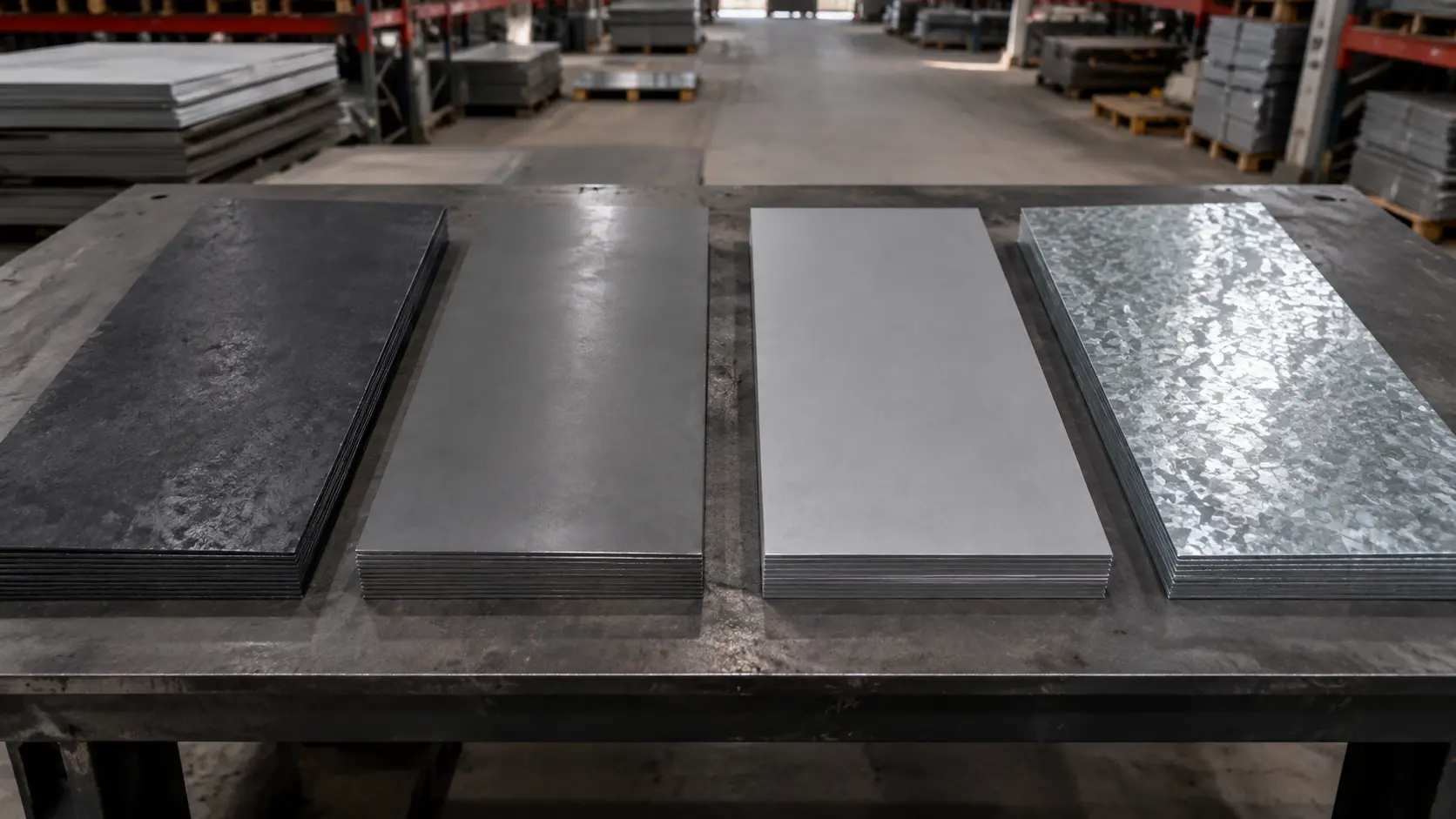
Four names, four different surface strategies
Thickness and sheet size alone are rarely enough for a useful quotation. Hot-rolled black sheet, pickled-and-oiled hot-rolled sheet, cold-rolled sheet and galvanized sheet of the same nominal size can behave very differently in surface preparation, dimensional control, forming, painting and corrosion protection. The wrong choice may still be usable, but it can add cleaning, coating, scrap and workshop time.
These names are not complete steel grades. Chemistry, mechanical properties and the applicable product standard must be specified separately. Cold-rolled is not automatically stronger, and galvanized steel is not permanently rust-proof. Start with the fabrication method and service environment, then define grade, thickness, coating and documentation requirements.
Hot-rolled black sheet: the general fabrication option
Hot-rolled black sheet is produced by rolling steel at elevated temperature. A natural oxide layer, commonly called mill scale, forms on the surface. It therefore looks darker and less uniform than cold-rolled sheet, and minor surface marks or broader appearance tolerances may be normal.
It is widely used for machinery parts, chassis, platforms, welded fabrication and thicker components. For load-bearing work, however, grade and thickness must follow the engineer’s calculations rather than workshop habit. Before painting, mill scale, rust, oil and contamination must be removed to the level required by the selected coating system.
HRP: hot rolled, pickled and oiled
The Turkish market term HRP usually refers to hot-rolled sheet whose mill scale has been removed by acid pickling and whose surface has been lightly oiled for temporary protection or lubrication. The base remains hot rolled; the main advantage is a cleaner surface that is easier to prepare for downstream work.
HRP can be a practical choice for laser or plasma cutting, bending, welding and painting when the fabricator wants more controlled surface conditions. The oil film is not a permanent outdoor coating. It must be removed as required before painting or bonding, and moisture or condensation during storage can still cause corrosion.
Cold-rolled sheet: smooth surface and precise forming
Cold-rolled sheet, often called DKP in Türkiye, is made from hot-rolled material through additional stages such as pickling, cold reduction, annealing and temper rolling. These operations help produce a smoother surface, closer gauge tolerance and more controlled strip shape.
It is commonly selected for electrical enclosures, cabinets, covers, furniture parts, appliance components, precise bending and deep drawing. A smooth surface does not provide corrosion resistance by itself, so paint or another protective finish is usually planned. Formability also depends on the ordered grade, not simply on the word cold-rolled.
Galvanized sheet: added protection from a zinc coating
Galvanized sheet is steel coated on both sides with zinc, commonly by a continuous hot-dip process. The zinc layer offers better corrosion protection than bare steel, making the product useful for ventilation ducts, roof and façade details, enclosures, outdoor components and parts exposed to intermittent moisture.
Service life still depends on coating mass, environmental corrosivity, cut edges, water traps and contact with dissimilar metals. Cutting and welding locally damage the coating and affected areas may need repair in accordance with the manufacturer’s instructions. Welding galvanized steel can produce zinc-containing fumes, so correct procedures, extraction and personal protective equipment are essential.
Which one fits the job?
Compare total fabrication effort, not only material price. Cleaning, cutting quality, paint preparation, forming, maintenance and the service environment can change which option is most economical overall.
- General welded fabrication and thicker parts: hot-rolled black sheet, or HRP when a cleaner surface is valuable.
- Laser cutting, controlled bending and paint preparation: HRP can provide a practical starting surface.
- Enclosures, panels, covers and precision forming: choose a suitable cold-rolled forming grade.
- Moist or outdoor exposure: consider galvanized sheet with the appropriate zinc coating specification.
- Load-bearing or safety-critical parts: grade and thickness must be selected by engineering calculation and the applicable standard.
Information to include in a quotation request
Instead of asking only for “2 mm sheet”, send the details below in one message. This helps the supplier check the correct product, available alternatives and cutting plan. Never substitute a grade or size in a critical application without technical approval.
- Product type: hot-rolled black, HRP, cold-rolled or galvanized
- Thickness, sheet width and length
- Quantity, total area or approximate tonnage
- Required grade, standard, zinc coating class and certificate, if applicable
- Downstream operations such as cutting, bending, welding, deep drawing or painting
- Indoor, coastal, continuously damp or chemically exposed service conditions
- Critical surface appearance and tolerance expectations
- Delivery, transport and packaging requirements