
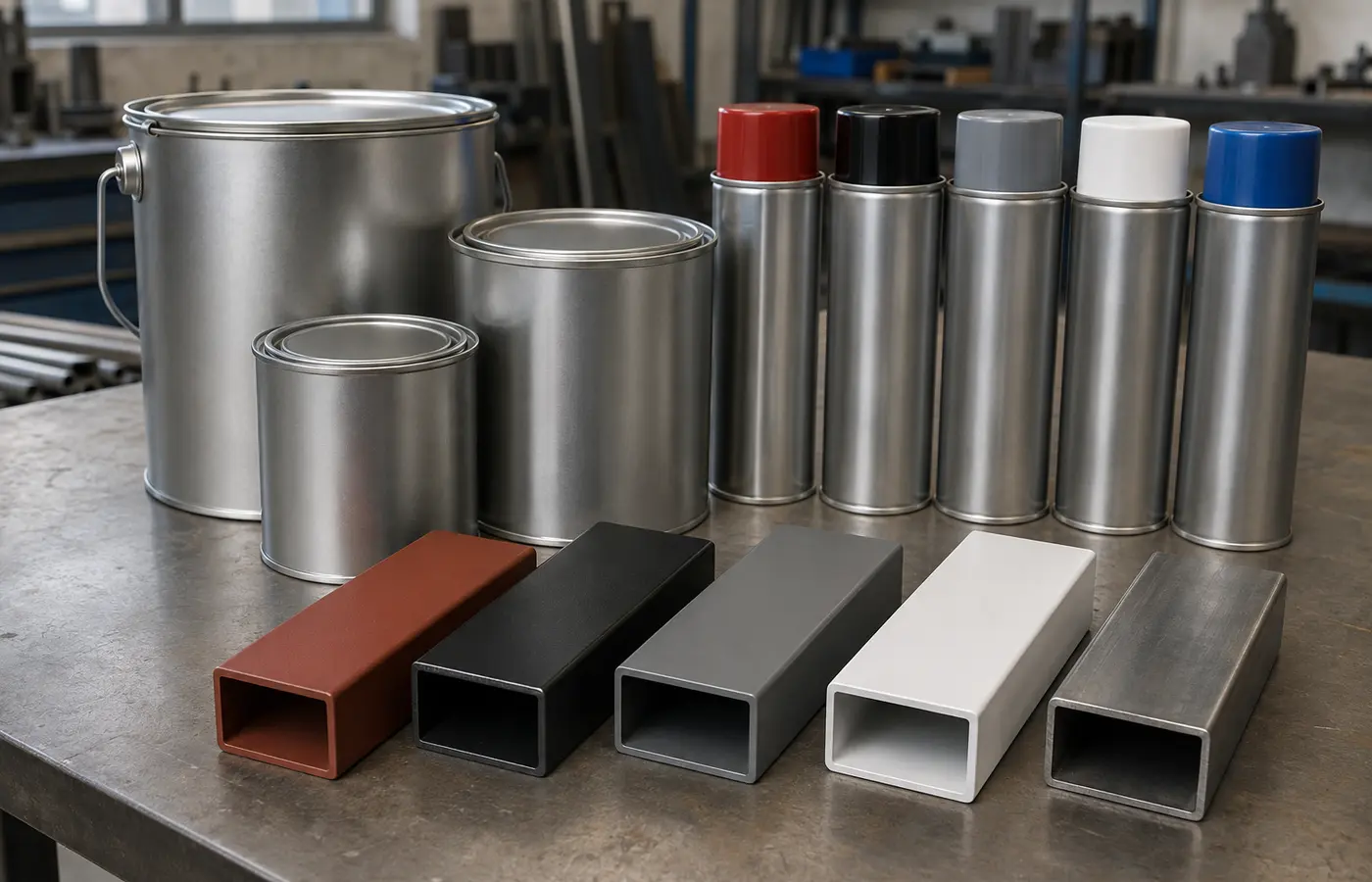
Start by identifying the substrate and exposure
The same colour will not perform identically on every steel surface. New black steel may carry mill scale and process oil; old fabrication may have rust, loose paint and weld residue; galvanized steel requires attention to the zinc surface and its condition. Identify bare steel, shop primer, galvanizing, existing paint or a mixed substrate before selecting a system.
Define whether the item works indoors, outdoors, near the sea, under frequent wetting or around chemicals. Primer, intermediate coat and finish operate as one system. Compare the coating data sheets for substrate, preparation and intercoat compatibility rather than selecting by colour or product name alone.
1. Remove oil and salts before mechanical preparation
Cutting oil, grease, fingerprints, silicone, salts and workshop dirt can weaken adhesion. Abrading a greasy surface may spread contamination or drive it into the profile. Complete the coating manufacturer's approved degreasing and any required water cleaning before sanding, wire brushing or blasting.
Turn wiping cloths to a clean face and do not return dirty solvent to the work. Verify that compressed air is free of oil and water. In coastal work, soluble salts may not be visibly obvious; where critical, the coating specification must define the test and acceptance limit.
2. Remove rust, loose scale and weak old paint
Mill scale may look hard but can detach with the coating when it loses its bond. Remove loose rust, weld spatter, sharp burrs and unstable edges to the preparation level required by the paint system. Hand tools, power tools, sanding, grinding or abrasive blasting are selected by duty, access, expected life and the data sheet.
Complete removal of old paint is not always required, but any retained coat must be sound and compatible. Test a small area for cleaning, keying and intercoat reaction. Feather old edges; a thick new coat cannot strengthen a weak layer below.
3. Create the profile the coating requires
Cleanliness and roughness are different. Some coatings need a defined surface profile for mechanical adhesion. A glossy smooth surface may reduce grip, while an excessively deep profile can leave peaks under-covered and increase consumption. Match the abrasive and method to the coating specification.
Do not grind galvanized steel as aggressively as bare black steel and unnecessarily remove zinc. New, weathered and passivated galvanizing can require different preparation. Coordinate cleaner, sweep abrasion, conversion treatment or special primer with both galvanizing and coating guidance.
4. Treat welds, edges and recesses before full coats
Liquid paint tends to pull away from sharp edges, leaving a thinner film. Welds, bolts, corners, holes and recesses can also be shadowed during spraying. Remove burrs and spatter, clean weld residue and round edges as required.
Where the system calls for it, brush a stripe coat onto these details before the main coats. It improves coverage but cannot compensate for rust or contamination. Open hollow-section ends, water traps, gaps and drainage also belong to the corrosion design.
5. Control primer, recoat window and film thickness
A primer name alone does not prove suitability. Bare steel, galvanizing, existing coatings and hot surfaces can need different binders or preparation. Confirm that every coat is approved over the previous one and follow mixing, induction, thinner and equipment instructions.
Too little film may not provide the barrier; one excessive coat can trap solvent, wrinkle or cure slowly. Track wet and dry film targets and both minimum and maximum recoat intervals. An exceeded window may require cleaning or abrasion before the next coat.
6. Check steel temperature and dew point
Warm air does not guarantee a dry steel surface. Condensation may form early, late or on shaded metal. Follow the manufacturer's limits for surface temperature, relative humidity and dew-point margin, and postpone work in rain, fog, strong wind or dust.
Touch-dry is not fully cured. Handling, stacking, immersion, impact and chemical exposure may each require longer. In coastal conditions, do not leave a prepared surface unprimed for longer than the specification permits.
7. Information for one complete enquiry
Send the following together:
- Substrate: black steel, galvanized, primed or previously painted
- Indoor/outdoor duty and exposure to coast, moisture, water, UV or chemicals
- Condition of rust, scale, oil, welds and old coating
- Available cleaning and profiling method
- Colour, appearance, complete coating system and maintenance target
- Brush, roller or spray method and total area
- Primer, intermediate, finish, thinner and stripe-coat requirements
- Recoat windows, cure time and dry-film target