
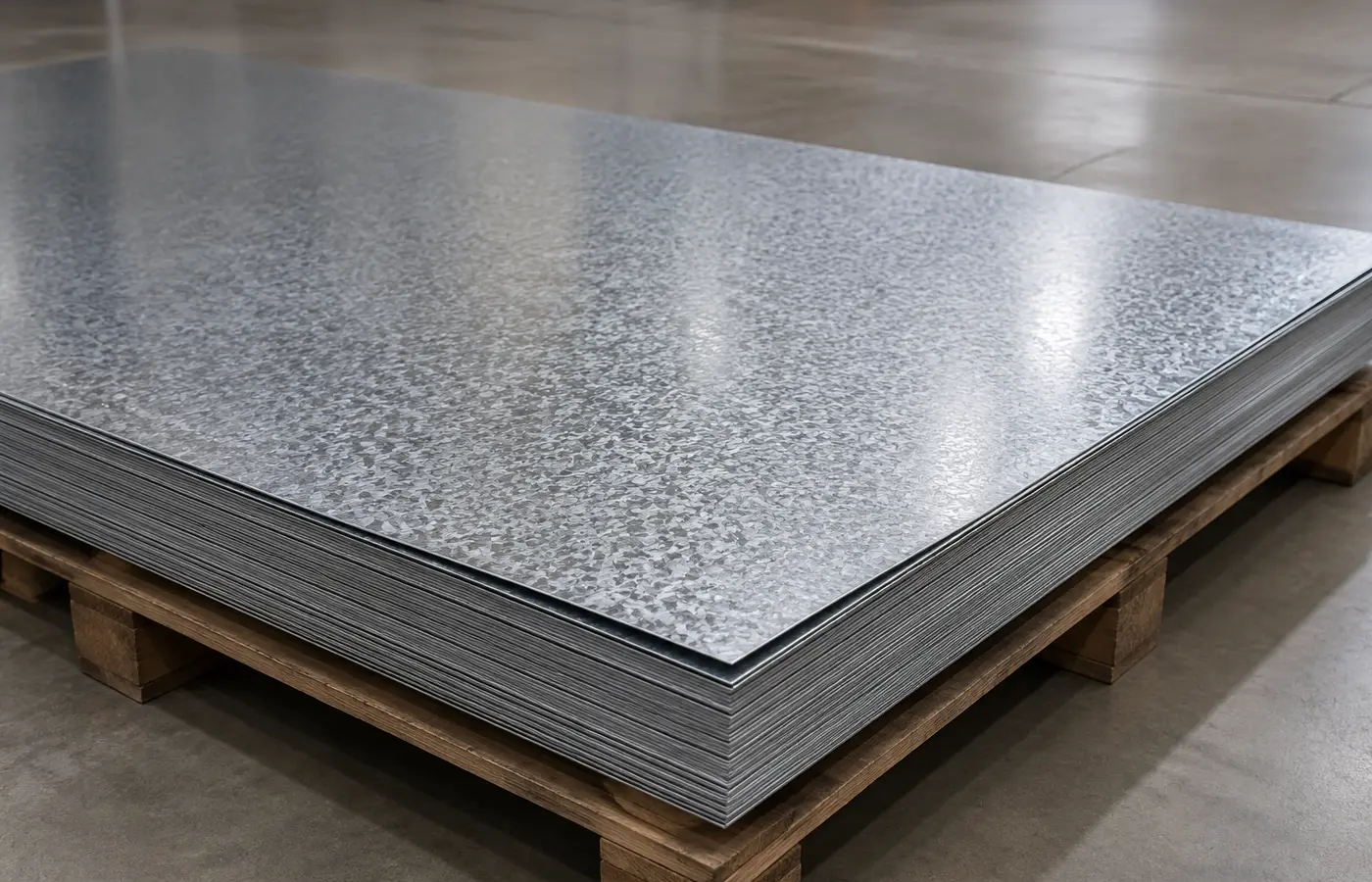
Appearance is not a specification
A bright or spangled surface does not define steel thickness, coating mass, grade, forming performance or service life. Start with the application and use the project standard and manufacturer documentation for critical work.
Two sheets of the same size can behave differently during bending, welding, painting and exposure. State whether the material is for indoor fabrication, roofing details, cladding, agricultural buildings or machinery.
1. Separate thickness from coating
Clarify whether thickness refers to the steel substrate or the coated product, and state the applicable tolerance. A single calliper reading may not represent the sheet.
Specify the zinc coating class or mass required by the project. More coating is not automatically best for every forming, welding, painting and cost target.
2. Match the grade to processing
Bending, deep drawing, pressing and roll forming require suitable formability. Tight radii, an unsuitable grade or incorrect rolling direction can crack the coating or tear the steel.
Welding coated steel requires a qualified procedure, fume extraction, ventilation, PPE and a plan to restore corrosion protection around affected areas.
3. Define sheet, coil and cut parts
For repeated parts, slitting or cut-to-length supply may reduce scrap and handling; standard sheets may suit small mixed jobs. Share dimensions, quantities, cutting allowance and rolling-direction needs.
State burr direction, dimensional tolerance and flatness. Thermal cutting may affect edge coating, so exposed cut edges may need a compatible protection system.
4. Plan finish and paint
Spangle, colour variation, passivation and protective oil depend on product type. Agree a reference sample when appearance matters.
Remove contamination and use a surface-preparation, primer and topcoat system approved for galvanized steel. Do not assume weathering alone prepares every paint system.
5. Prevent wet-storage stain
Water trapped between tightly stacked sheets can cause white corrosion products. Store the material dry, ventilated, raised from the floor and protected from water entry without trapping condensation.
Open wet packs promptly, separate and dry sheets safely. Inspect dents, scratches, waviness, moisture and white stain before fabrication.
Quotation checklist
Provide:
- Application and exposure
- Standard, grade and nominal thickness
- Zinc coating class
- Sheet or coil dimensions and quantity
- Cutting, slitting, holes, bending and tolerances
- Finish, passivation/oil and paint plan
- Edge protection, packing, transport and storage
- Certificates and traceability