
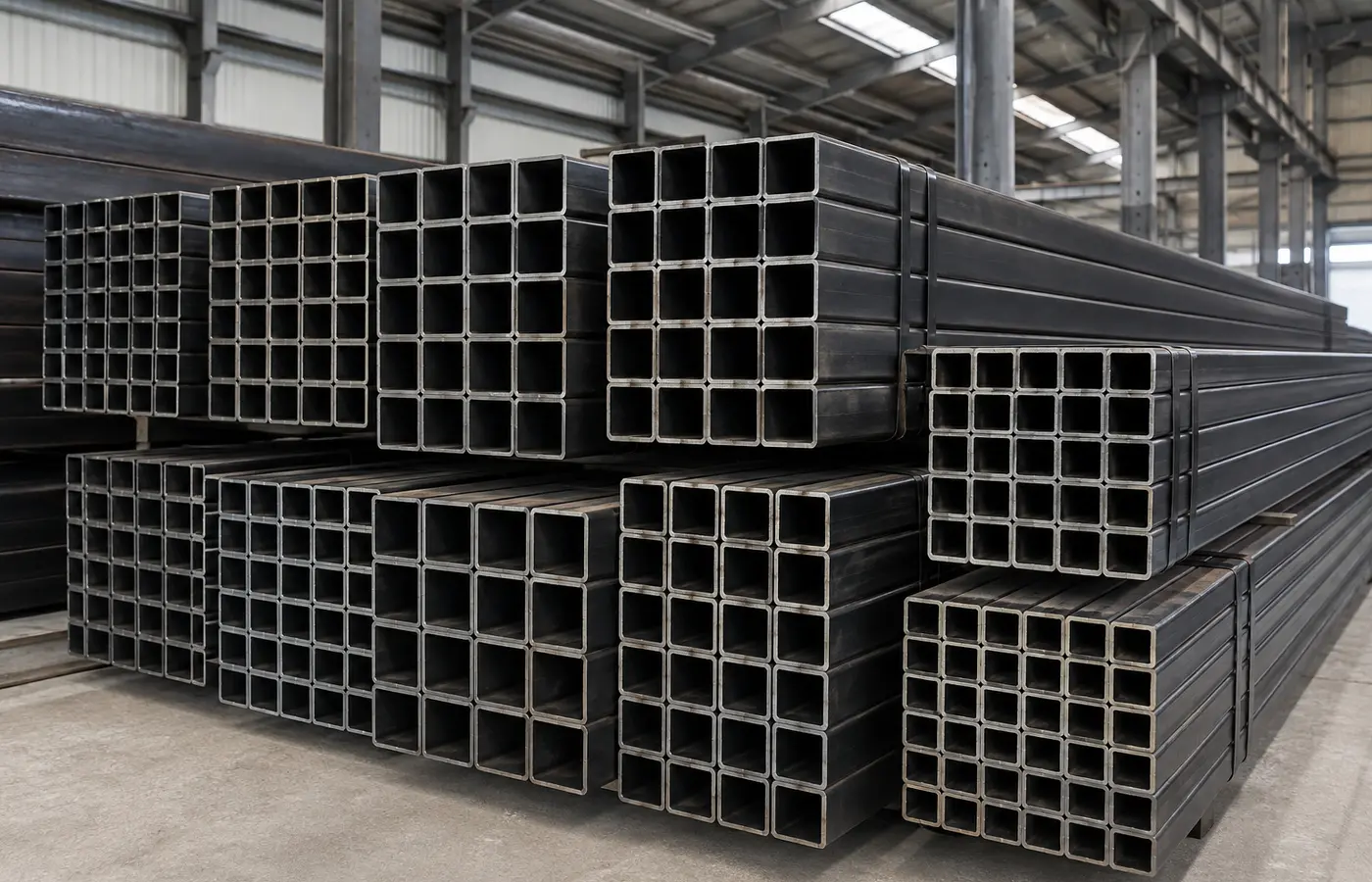
Do not select by outside dimensions alone
Square and rectangular hollow sections are used in gates, machine frames, canopies and steelwork. Yet descriptions such as '40 mm box' or '60 by 40' are incomplete. Outside dimensions must be accompanied by wall thickness, steel grade, product standard, length, tolerances, surface condition and intended use.
ISO 10799-1:2011 covers technical delivery conditions for cold-formed welded circular, square and rectangular structural hollow sections; ISO 10799-2:2011 covers tolerances, dimensions and sectional properties. Their scope does not mean that every product with the same outside size has the same capacity. Confirm the product standard and national rules applicable to the project.
When does a square section help?
A square section is a practical starting point when similar geometry is wanted about both principal axes. Its symmetry can simplify detailing where the installed face may change or loading can come from two directions. Small frames, posts, gates, tables and general workshop fabrications are common examples.
Symmetry does not make an SHS automatically stronger. Buckling length, supports, connection eccentricity, holes, welds and actual loads still govern. A responsible engineer must select sections for columns, guardrails, suspended loads, occupied platforms and overhead elements.
When does a rectangular section stand out?
An RHS can place material efficiently in beams, rails, frames and chassis members where bending mainly acts in one direction. Orienting the deeper dimension in the effective bending direction can change stiffness substantially compared with rotating the same section by 90 degrees. The drawing should therefore show orientation as well as dimensions.
If the load direction can change, torsion occurs or the frame works about two axes, the simple rule of placing the long side vertically is insufficient. Section properties, span, restraints and load combinations must be calculated together. Tables help with preliminary selection but do not replace final verification.
Read wall thickness, grade and section data together
A larger outside size is not always adequate, and extra wall thickness alone does not settle the design. Grade, corner radii, manufacturing route, local buckling, seam and dimensional tolerances all influence behaviour. Agree the permissible tolerances for the nominal wall thickness at quotation stage.
If inspection documents are required, specify grade, batch traceability and document type before ordering. A service-support frame and a primary load-bearing member may have different acceptance requirements even when their trade names match. Do not substitute tested service pipe and structural hollow section by appearance alone.
Connections and fabrication can change the choice
The clean closed form is useful, but limited access to the inside affects bolts, nuts and coating details. End plates, cleats, blind fasteners, sleeves or welded joints should be selected early. Thin-wall crushing, face deformation, tearing and stresses around welds may require design checks at connections.
A cut list should state finished length, cut angle, hole centres, weld preparation, end caps and deburring. Welding sequence and fixtures should control heat distortion. Cut and welded areas on painted or galvanized steel must be re-protected with the approved preparation and repair system.
Do not trap water in coastal environments
Salt-laden moisture, open ends, weld gaps and water pockets can raise corrosion risk. Randomly sealing every end can also trap condensation or create pressure hazards during coating. Drainage and vent holes must be designed with section orientation, coating process and fabricator instructions.
Primer, finish paint and hot-dip galvanizing are different systems. Select for the environment and follow the product data for preparation, layer compatibility, dry-film thickness and repairs to cut edges and welds. A detail that cannot be inspected or maintained may create future cost despite looking tidy on day one.
Information for an accurate quotation
Send a short duty description and a dimensioned drawing, not just the section name.
- Square or rectangular section and installed orientation
- Outside dimensions, wall thickness, length, quantity and tolerances
- Steel grade, product standard and required documents
- Structural or non-structural duty, span and load information
- Cutting, holes, welding, caps, deburring and part labels
- Indoor, outdoor, coastal, wet or chemical exposure
- Primed, painted, galvanized or uncoated delivery
- Packing, transport, unloading and site length limits