
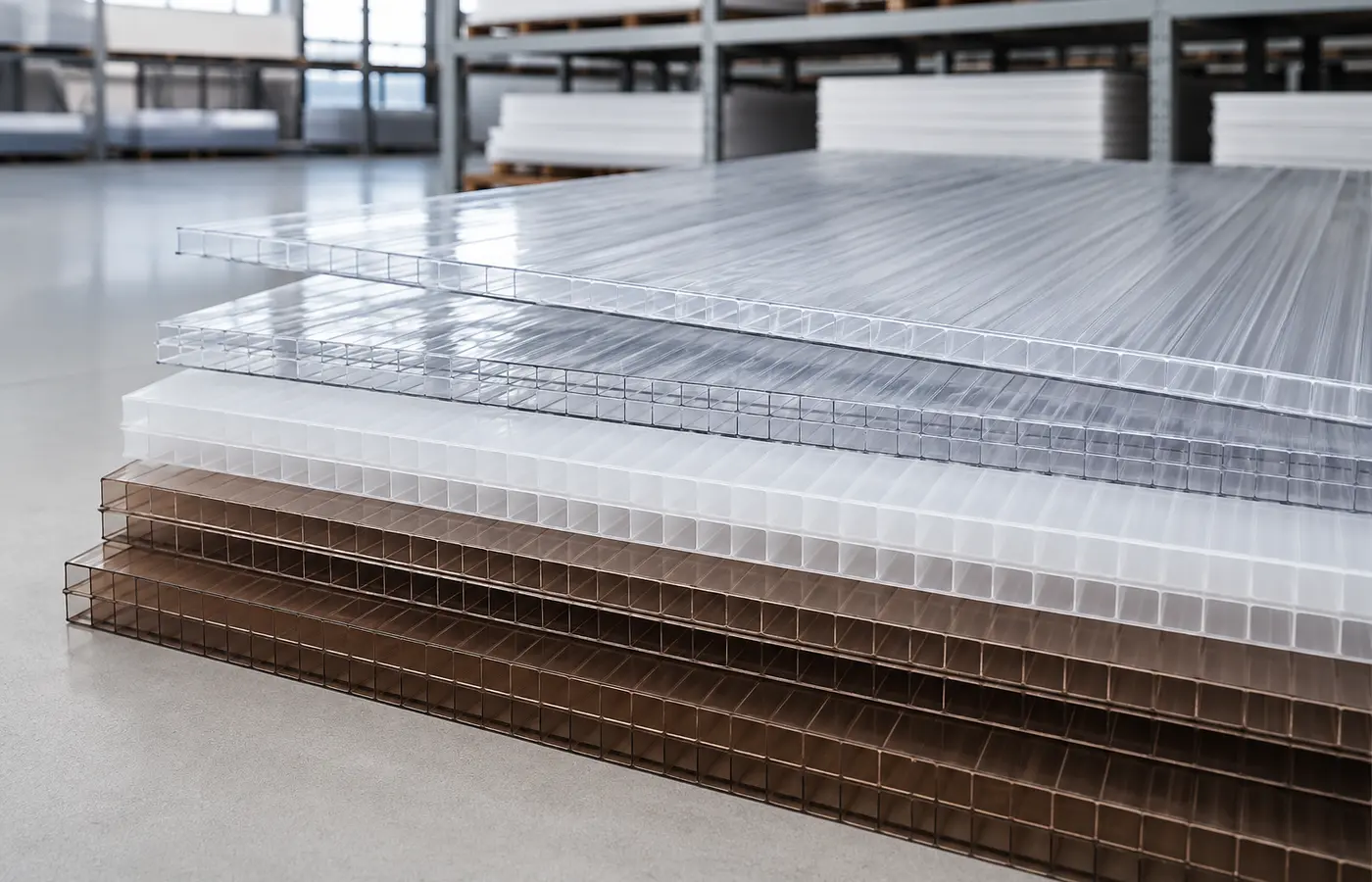
Thickness alone does not define the sheet
Solid, multiwall and corrugated polycarbonate serve different purposes. Define whether the job needs rain cover, daylight, visibility, insulation, solar control or guarding.
Roof and façade loads, spans and connections require engineering. Impact resistance does not make a sheet walkable or suitable for any unsupported span.
1. Choose solid or multiwall deliberately
Solid sheet suits glass-like guarding and glazing; multiwall construction can provide lower area weight and better insulation. More walls are not automatically better in every respect.
Use the manufacturer's load tables for the exact thickness, width and support spacing, including wind, snow and maintenance loads.
2. Face the marked UV layer outward
Many products have a UV-protective layer on one marked side, which must face the sun. Some products protect both sides; verify the label and data sheet instead of guessing.
Keep orientation marks during cutting so every piece is installed correctly. The UV layer protects the sheet from degradation; check product data for any separate occupant-protection claim.
3. Compare light and solar heat together
Clear, bronze, opal and solar-control colours differ in visible light, glare and heat gain. Compare light transmission and solar performance for the same product and thickness.
In sunny coastal locations, maximum transparency may overheat a pergola, while a very dark panel can remove useful daylight. Consider orientation, ventilation and shading.
4. Allow thermal movement
Do not clamp sheets tightly, drill holes only screw-size, or overtighten fasteners. Follow the specified expansion gaps, hole sizes, overlaps, washers and gaskets.
Compatible aluminium profiles and seals must match sheet thickness. Random sealant does not replace a designed glazing system.
5. Detail drainage and cell direction
Use the manufacturer's minimum roof pitch and details at eaves, walls, ridges and gutters. Fastener position depends on the panel system.
Orient multiwall cells so condensation can drain. Use the specified closed upper tape and ventilating lower tape/profile rather than leaving cells open or sealing moisture inside.
6. Protect during fabrication and cleaning
Store sheets flat, dry and away from heat trapped under packaging. Support them during cutting, use a suitable sharp tool and remove swarf from cells.
Use soft cloths and approved mild cleaners. Verify chemical compatibility of sealants, tapes, gaskets and solvents.
Quotation checklist
Provide:
- Application and dimensions
- Solid, multiwall or profiled construction
- Thickness, colour, daylight and solar target
- One- or two-sided UV protection
- Pitch, spans, supports and loads
- Cut sizes, cell direction and bending
- Profiles, fasteners, washers, seals and tapes
- Packing, storage and cleaning